Our Patent Guide Everything One Should Know About Patent And Patent Process
 |
| Our Patent Guide Everything One Should Know About Patent And Patent Process |
PATENTS are protection given to your inventions. Once you create something- product process, installation techniques, software workings- you must directly opt for registration under Patent Law.
An investor who is unfamiliar with all these is putting himself under the bus. You invent and not protect that invention- how can someone not protect what they have built up with so much effort. All the hard work goes in vain if you are negligent with this very step — patent registration. Some inventors think that once they hire a patent attorney, they are relieved from all obligations. They fail to understand that an attorney will work only if you provide them with relevant and required details from time to time. You need to work in close contact with the patent attorney and provide him the entire big picture to the minor because they need to know everything related to the invention. Inventors play a crucial role in leading the team to a successful patent grant because they describe the invention that will be detailed in the patent description application. Unlike trademarks, the patent application is complicated for the one to do it themselves. Therefore, it is advisable to always, we repeat, always hire a patent attorney and file your application. Before applying, these are the things you must check for in your invention so that if there is any issue, it can be solved at the preliminary stage. Checklist Does it involve a unique, inventive step? Will it be possible to apply your invention in industries? Does it fall under the non-patentable category? Does your invention depict your intent for a patent? Which is the category of Patent you need to register for? (we can attach the link here — different types of Patent) Are all the documents ready for applying for the Patent? Once you have filled up the checklist, we will now understand the basics of patent law and the process given under the Indian Patent Act. It is essential to mention here that this particular one — of all the IPR processes –the patent process is a little cumbersome and complicated, so you need to keep patience throughout the process. We will unfold the answers to a few basic questions and then get into the process of application.
PATENT is a statutory right granted for an invention that is novel and not available in the public domain. The Government grants these rights to the patentee after full disclosure of the information related to the invention. This right is given for a limited period — 20 years from the date of filing of the application. Unique features that can be listed out for a patent are:
The most exciting question everyone inventor asks is why should we patent our invention? The answer is as simple as it can be –
One mistake every inventor tends to make is to think that their ideas can be patented. They fail to understand that under patent law- “it is your invention that can be patented and not your ideas.” There is no protection given to ideas or concepts, or thoughts under the patent law. The Patent’s central concept is to give protection to the process or techniques associated with the invention, so the ideas cannot possibly fall into the patentable category. Section 10 of the Indian Patent Act mentions that inventions capable of industrial application can be patented. The Act does not directly restrict the ideas from the patentable subject matter. However, the thin line difference clarifies that only those subjects that fall under the Section 10 category can be patented. There are arguments that ideas are novel, industry applied, and non-obvious to the skilled person, but if an idea is capable of everything, why not convert it into an invention and file a patent for it. There is no perfect answer as to if ideas can be patented or not, but as for the practice- ideas are not the patentable subject matter. Before we apply for any patent-the first step we have to do mandatorily is to conduct a PATENT SEARCH. A patent search is a search of all the issued and granted patents on the government portal, which can be used to check whether the invention by you is unique and does not fall under the category of the prior art. A patent search is usually done before applying the Registry so that if any discrepancy shows up, the inventory can modify it. Conducting a patent search looks like an easy task, but it requires many professional skills and knowledge to conduct. It is imperative to hire a professional in conducting a patent search. One of the main reasons for conducting the patent search is to check whether the inventions fall under prior art or not. Prior art helps identify the closest and connected invention to the proposed invention so that a lot of time can be saved on the prosecution stage. It helps to evaluate whether the invention is eligible for Patent or not. That is why this step is considered to be the stepping stone of patent protection. After successfully crossing the prior art search, the inventor has to check if the invention proposed to be patented is
If all the answers are in affirmation, then you are good to go. Go ahead and register your invention. Now that we are aware of the Patent’s basics, it will be easy for us to understand the process. For beginners- these tips to patent filing will come in handy:
The detailed procedure for patent registration Step- 1: Patent search: Before filing the application, one has to conduct a patent search and check the eligibility of registering the Patent. Step- 2: submission of provisional specification/ complete specification: After a thorough patent search and preliminary check- the next step is to draft a patent application as per FORM-1, accompanied by the patent specification as per FORM-2 If one files a provisional specification- then a complete specification has to be filed within 12 months. In case of default, the applications stand abandoned. Step- 3: Publication of application: After 18 months of the filing of the application, the application will be published. However, a request for early publication (within nine months) can be made at the patent office. Step- 4: Request for examination: Once the application is filed, a request for examination of the application must be made within 48 months from the date of filing of the application or priority date as per FORM-18. The earlier done is better. The Patent Officer will conduct a thorough search and then draft a FER (First Examination Report), which will contain a detailed analysis of the invention and objection if any. Step- 5: Examination report and reply to objections The examination report will be sent to the patentee, and if there are no objections recorded- the application will be published for pre-grant oppositions.
Step- 6: Pre-grant oppositions: After the application is published, as per Section 25(1) — any third party or the Government can challenge the grant of the application after publication but before the grant. Any person challenging the grant has to file in writing as per FORM 7-A the grounds of opposition and submit it to the Registrar within six months from the date of publication. Note: pre-grant oppositions can be filed even before the examination of the application is concluded. However, it will be considered only after a request for examination is placed. Step- 7: Reply to Oppositions: In case any opposition is filed, the entire process of reply, evidence submission, and hearing process will occur. Once all the oppositions are apparent, the Patent Officer will grant the Patent. Step- 8: Grant of Patent: Once everything is clear, the Patent will be granted, and the invention will be open for any post-grant opposition. Step- 9: Post-grant opposition: After the Patent is granted, within 12 months, any person can file for post-grant opposition as per FORM-7 along with prescribed fees on the grounds laid down under Section 25(2). If any opposition is filed, then the process of opposition will be conducted. Step- 10: Renewal of Patent: If no oppositions are filed, then the grant is confirmed, and such grant has to be renewed from time to time. PATENT OPPOSITION IN INDIA — OVERVIEW GROUNDS OF OPPOSITION: Provision: Section 25(1)(a) to (k) details down the grounds of opposition for pre-grant opposition-
PROCEDURE OF OPPOSITION: Provision: Section 25 details down the procedure of opposition for pre-grant opposition- The procedure for the opposition is straightforward and easy. It is the same necessary procedure we have for the rest of the IP Rights. Without going into many details, we decided to sum up the procedure in three simple steps:
PRE-GRANT VS. POST-GRANT OPPOSITION PROCEDURE 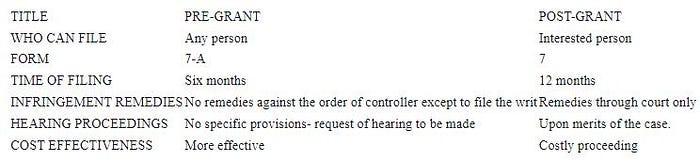 FORMS AND FEES 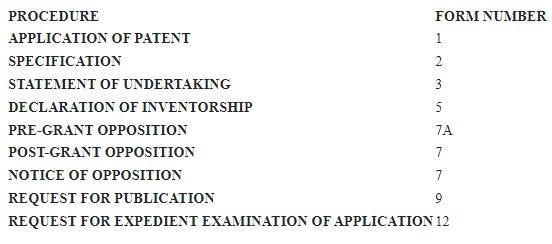 FEES CAN BE ACCESSED FROM THE LINK : http://www.ipindia.nic.in/writereaddata/Portal/IPOFormUpload/1_11_1/Fees.pdf 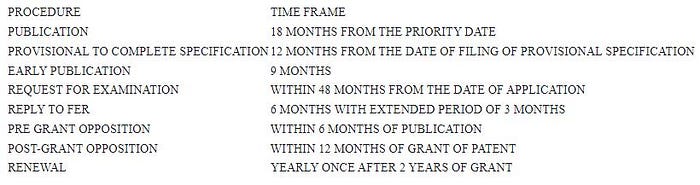 To know more: https://www.unimarkslegal.com |


Comments
Post a Comment